Oct 20, 2026Buying Guides
How Accurate Is a Digital Scale? Resolution vs Accuracy Explained
Why a 0.01 g display does not guarantee 0.01 g accuracy — and how to read a specification sheet without being misled.
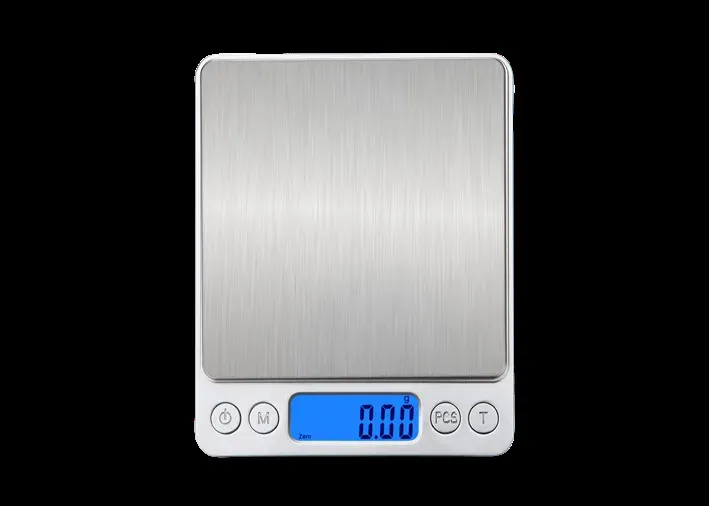
Resolution is what the display shows
The display step — 1 g, 0.1 g or 0.01 g — is resolution. It tells you how finely the scale reports a value, not how close that value is to the true mass. A scale can display 0.01 g and still be outside its stated accuracy. Marketing often quotes resolution because it is the bigger-looking number.
Accuracy and linearity are different properties
Accuracy is how close the reading is to the true mass. Linearity is how consistent the error is across the range. A scale can be accurate at mid-range and drift near its maximum. This is why a specification sheet pairs each capacity with a precision: 3kg/0.1g, 5kg/0.1g, 10kg/1g.
Read the capacity ladder, not just the best number
The finest step usually applies only to the lowest range on that platform. The DH-5KW reads 0.01 g at 500 g and 0.1 g up to 3 kg. The DH-456A reads 0.001 g up to 600 g and 0.01 g up to 3 kg. If your buyers weigh at the top of the range, the top-range step is the number that matters.
Environment moves the reading
Air drafts, vibration, temperature and an uneven surface all affect a scale. At 0.001 g, a draft shield is not decoration: it encloses the pan so air movement does not register as mass. At 1 g on a 20 kg platform, the same draft has far less effect. Match the environment to the resolution.
How to verify a scale you receive
Weigh a known reference at the range you use, repeat the load, and check the return to zero. Record the result. If the reading drifts, recalibrate and repeat. This simple routine catches most problems before they reach a customer.
Ask for the full ladder
ZmoTek publishes the complete capacity and precision table for every model. Tell us the range your buyers weigh in and we will confirm the step at that point.