Oct 20, 2026Buying Guides
Coffee Scale vs Kitchen Scale: What Actually Differs
Resolution, response time, timers, surface and size — the practical differences between a coffee scale and a kitchen scale, and when one can replace the other.
They look similar, but they are tuned differently
Both weigh in grams, and both use a strain-gauge platform. The difference is in what the scale is tuned to do. A coffee scale is built around a brewing sequence: it needs a timer, a display that updates quickly, and a footprint that fits under a dripper. A kitchen scale is built around capacity and a large pan.
Resolution and speed
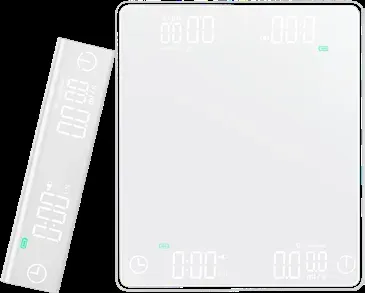
Coffee doses are small, so 0.1 g readability is the norm. Our coffee line reads 0.1 g across the range, with capacity depending on model: the DH-8702 spans 1 kg to 5 kg, while the DH-8705, DH-8705D and DH-E70 cover 3 kg and 5 kg. The DH-8705D adds a detachable display head showing flow rate in ml/s.
Timers and brewing support
A timer is the feature that separates the two categories in daily use. The DH-8702 includes a built-in timer, the DH-8705D shows timer, weight and flow rate together, and the DH-E70 adds a silicone draining mat over the platform. A kitchen scale without a timer forces the user to reach for a phone mid-brew.
Surface and cleanup
Coffee work is wet: spills, drips and rinsing. A coffee scale usually has a flat, wipeable surface, sometimes a removable mat. Kitchen scales with textured or glass platforms can be wiped too, but a draining mat is designed for the wetter workflow.
When a kitchen scale is enough
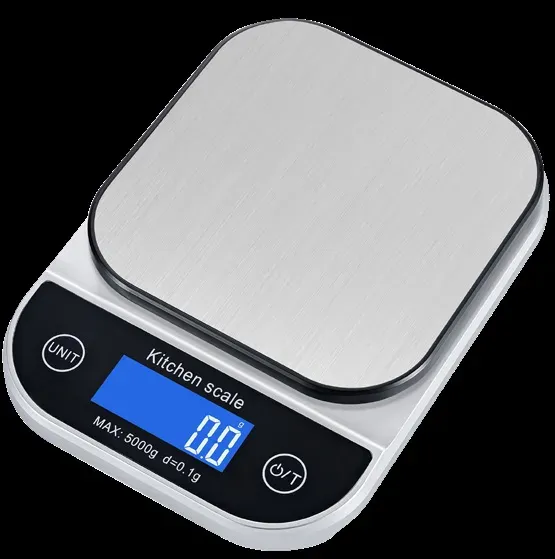
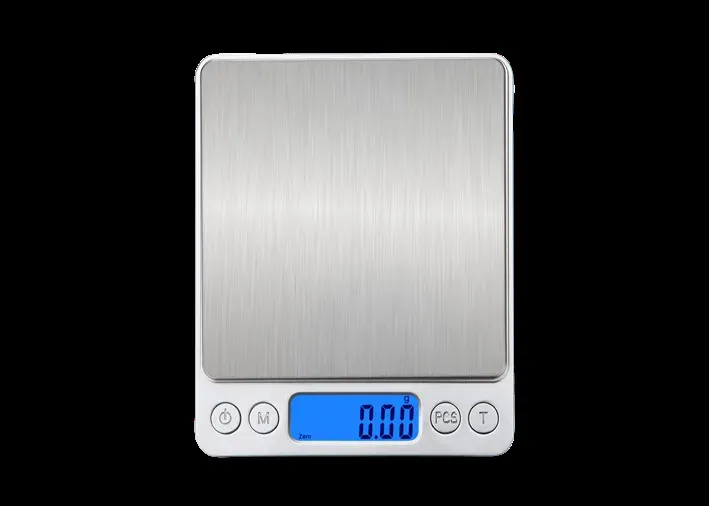
For filter coffee measured by weight without timing, a kitchen scale at 0.1 g or 1 g can work. The trade-off is response speed and the absence of a timer. For espresso and pour-over where timing is part of the recipe, a dedicated coffee scale is the better tool.
Compare models
ZmoTek stocks both categories: coffee models with timers and flow displays, and kitchen models with wide capacity. Tell us your brewing method and we will shortlist the right platform.