Oct 20, 2026Compliance
Waterproof Scales for Food Processing: What to Check
Sealed housings, stainless platforms, washdown routines and the specification details that separate a food-safe scale from a kitchen scale.
Why standard kitchen scales fail in wet environments
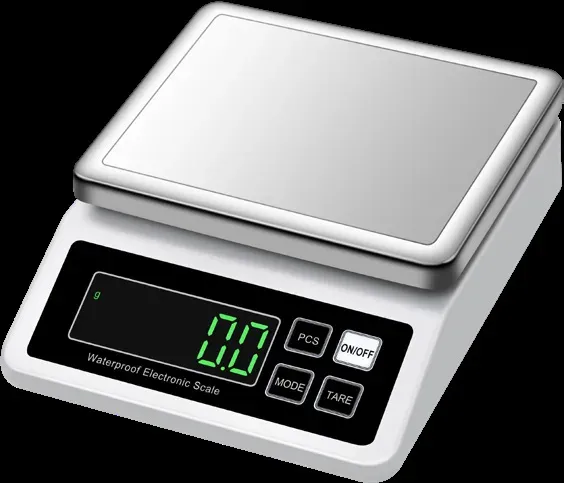
A kitchen scale is designed for a dry counter. In a fish, meat or produce area, water reaches the electronics through the battery door, the display seam and the button gaps. A washdown scale seals those points and uses a platform that can be lifted and cleaned.
Read the sealing and materials, not just the word waterproof
Ask for the sealing method and the platform material. Stainless steel trays resist corrosion and can be removed for cleaning. Our DH-8903 uses a stainless tray over a sealed body; the DH-8906 uses a full stainless platform. Confirm what the manufacturer means by waterproof, because the term is used loosely in the category.
Capacity and precision for food work
Food counters rarely need 0.01 g. The DH-8903 covers 3 kg to 15 kg with 0.1 g on the lower ranges and 1 g at 15 kg; the DH-AS01 reaches 30 kg at 1 g with a keypad and front and rear displays. Choose the step at the weight you actually pack.
Cleaning routine and the battery door
The battery door is the usual entry point for water. Confirm how it seals and how often the cells need changing. A rechargeable model removes that opening but adds a charging connector to protect. Match the routine to the model.
Check the certificate scope
Food equipment may fall under additional requirements in your market. Certificates for electromagnetic compatibility and materials declarations are a starting point, not a complete food-contact assessment. Confirm the applicable requirements with your compliance adviser before ordering.
Request the washdown models
ZmoTek stocks four washdown models across 10 kg to 30 kg. Tell us the application and we will confirm the right platform and sample.