Oct 26, 2026Buying Guides
Tea Scales: What to Check Before You Order
A tea scale works in front of customers. Housing, pan size, power and packing — what to confirm across four 500 g / 0.1 g formats before you order.
A scale that works in public
A tea scale is one of the few weighing instruments customers actually watch being used. It sits on the counter of a tea shop, a tasting bar or a packing bench, and it portions loose leaf in the 3 g to 8 g range where a 0.1 g step is the difference between a repeatable brew and a guess. The reading has to be right, and the housing has to look like it belongs on a tea table rather than in a kitchen. The ZmoTek tea line is built around both requirements: four models, all reading 500 g at 0.1 g in grams.
One capacity and resolution across the line
The four models — the DH-8022, DH-C02, DH-C03 and DH-CZ02 — each publish a single specification: 500 g capacity at 0.1 g readability, in grams. There is no ladder of capacity modes to explain to staff, and the step size covers typical leaf doses with headroom for a caddy or a small pot on the pan. For range planning this keeps the decision simple: the models differ in housing, pan and power, not in the weighing specification.
Grams only — confirm that suits your market
All four catalogue pages list g as the only unit. A gram-only display keeps the readout uncluttered and matches metric tea markets, but the set is fixed per catalogue rather than switchable in use. If your market quotes tea in ounces or buyers expect a conversion mode, confirm the unit set with the supplier in writing before ordering rather than assuming a kitchen-style multi-unit display.
Housings that sit on a tea table
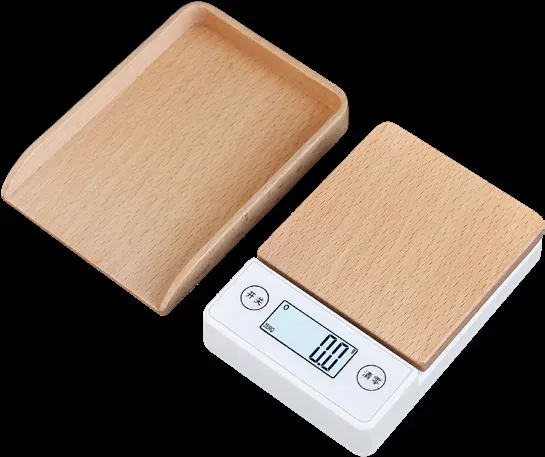
The housing is where the models separate. The DH-8022 pairs a compact body with an 11 x 8 cm wooden pallet that doubles as a presentation dish and lifts off for cleaning. The DH-C02 is an oval scale in three wood tones. The DH-C03 is a boat-shaped body in a red or black wood finish, and the DH-CZ02 is leaf-shaped in four finishes, with a slim 16.8 x 7.7 x 2.1 cm body sized for gift sets. For retail, the finish range is a merchandising decision: one model carried in four finishes gives buyers a colour choice without adding a second product line.
Pan sizes and what sits on them
Pan dimensions decide what can be weighed without tipping. The DH-C02's pan measures 10 x 8.8 cm, the boat-shaped DH-C03's platform runs 17.6 x 7 x 3.5 cm, the DH-CZ02 offers 13.4 x 6.6 cm, and the DH-8022's pan is 11.2 x 8.5 x 1.8 cm. A gaiwan, a caddy or a small bowl needs to sit stably while the reading settles — that is a test for the sample bench, not the spec sheet: place the vessel you actually use on the pan of each shortlisted model before you commit.
Power: three USB models, one dual-power option
The DH-C02, DH-C03 and DH-CZ02 charge over USB. The DH-8022 runs on two AAA batteries or USB, which makes it the model for counters and market stalls without a charging point. USB charging ties a scale to the place it charges, so decide where each unit lives before choosing. The catalogue does not list battery life or charge time for any of the four — test both on the sample instead of expecting a figure on the page.
Carton planning
Packing differs more between these models than the scales themselves do. The DH-8022 ships 100 pieces per master carton of 53.5 x 30.5 x 34 cm at 15 kg gross for the USB version and 14 kg for the battery version. The DH-C02 ships 39 pieces per carton of 55 x 47.5 x 25.5 cm at 11.8 kg. The DH-C03 ships 30 pieces per carton of 41.5 x 40.5 x 21.2 cm at 8.03 kg, and the DH-CZ02 ships 30 pieces per carton of 70 x 32 x 22 cm at 10.6 kg. On a mixed first order these counts are the smallest packing unit per model line, so plan the finished-goods space around them.
A short checklist before you order
Confirm the finish mix per model, the gram-only unit set against your market, where each scale will charge or take batteries, and the carton counts above. Then order one sample of each shortlisted model and dose the same 3 g and 8 g leaf portions ten times on the counter where it will live, checking that the reading returns each time. ZmoTek can quote the four tea formats side by side with the kitchen and coffee lines so the comparison happens on one page.