Oct 26, 2026Buying Guides
Spoon Scales: Choosing a Scale for Small Doses
A spoon scale doses a few grams at a time, at the point of use. Scoop design, capacity tiers, units and power — what to confirm before you order.
Weighing where a bowl will not fit
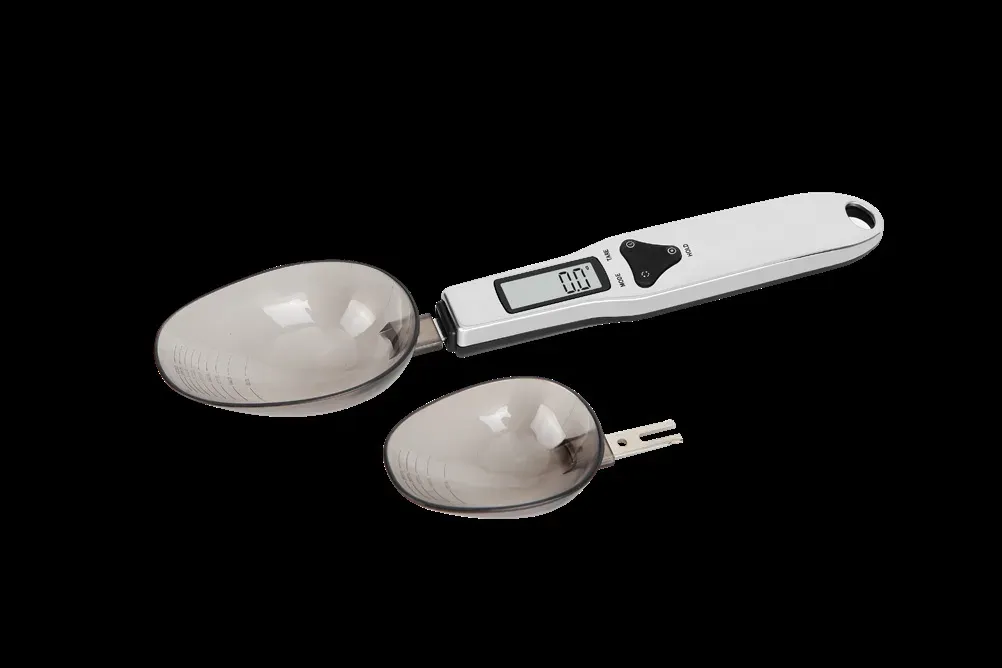
A spoon scale weighs at the point of dosing: the scoop is the pan. Spices portioned at a packing bench, supplement powders measured per serving, hobby materials weighed a few grams at a time — these are jobs where decanting into a separate bowl loses product and time. The ZmoTek spoon line covers this format with four models: the DH-328, DH-328A, DH-328G and DH-C328.
Capacity tiers: 300 g and 500 g at 0.1 g
The DH-328, DH-328A and DH-328G each publish two tiers — 300 g and 500 g — both at 0.1 g readability; the DH-C328 publishes a single 500 g tier at 0.1 g. The step size suits gram-level dosing, and the tiers cap what a single reading covers, not a day's throughput. If the job needs steps finer than 0.1 g, that is a milligram instrument, a different class; if it needs kilograms, that is a bench scale. Between those sit the gram-level doses this line is built to read at the point of use.
Four units on every model
All four models carry g, oz, gn and ct. Grams and ounces cover kitchen and packhouse work; grain (gn) appears in outdoor and hobby markets and carat (ct) in gemstone work, and both are standard on small-format scales of this class. The set is fixed per catalogue, so check it against the units your market quotes in rather than expecting a conversion mode to fill the gap.
Scoop designs: fixed, twin and interchangeable
The scoop is the working part, and this is where the four models differ most. The DH-328 is the classic form: a 23.2 cm body with a black 6.6 x 4.8 x 2.2 cm scoop. The DH-328A pairs a 16.1 cm body with two translucent scoops — a small 10.6 x 4.7 x 1.5 cm spoon and a large 11.8 x 5.8 x 1.8 cm cup. The DH-328G keeps the same 16.1 cm body length and adds interchangeable blue measuring cups plus a spoon head, and the DH-C328 is a 23.4 cm scoop format that comes in assorted colours. A scale that serves several materials benefits from scoops you can swap and wash instead of cross-contaminating one scoop — confirm how each scoop mounts when the sample arrives.
Tare and hold on the handle
The DH-328 lists mode, tare and hold controls on the handle grip. Tare resets the display to zero with material already in the scoop, which is what makes sequential dosing practical; hold keeps a reading on the display so it can be noted after the scoop is lifted. Both are small functions that decide whether the scale fits bench routine — use them in the sample test, not just the weighing.
Power: AAA on three models, a coin cell on one
The DH-328, DH-328A and DH-328G run on two AAA batteries. The DH-C328 runs on one CR2032 coin cell — a lithium-metal cell, which places that model under lithium-battery handling rules when it ships; the power-options guide on this site explains how that differs by lane. If your logistics partner does not take coin-cell shipments, the three AAA models avoid the question entirely.
Carton planning
The DH-328 ships 100 pieces per master carton of 60 x 46.5 x 29.4 cm at 13.7 kg gross. The DH-328A ships 50 pieces per carton of 63 x 49.5 x 26 cm at 8.58 kg, the DH-328G ships 50 per carton of 60 x 46.5 x 29.5 cm at 10.4 kg, and the DH-C328 ships 100 per carton of 52 x 30 x 44.3 cm at 9.05 kg. The counts and footprints differ per model, so a mixed first order needs each line planned separately.
A short checklist before you order
Match the scoop design to the material you dose, pick the 300 g / 500 g tier mix per model, check the unit set for your market, and confirm the battery lane your logistics partner accepts. Then order a sample of each shortlisted model and repeat the same dose ten times — 0.5 g, 2 g and 5 g are practical test points — checking that tare and hold — where fitted — behave the way your bench routine expects. ZmoTek quotes the four spoon formats alongside the kitchen and coffee lines so the comparison happens on one page.