Oct 22, 2026Buying Guides
0.001 g Scales: What Milligram Resolution Requires
A 0.001 g scale is not a kitchen scale with two extra digits. What to check in the spec sheet, on the sample bench and in the master carton before you order.
The last digit is a claim you have to support
A 0.001 g scale divides one gram into a thousand steps. That is one milligram per division, and it is the point where the bench the instrument sits on starts to matter as much as the load cell inside it. Buyers who compare models on the resolution line alone usually discover the difference after the first customer complaint, so it is worth knowing what the specification is really promising.
Several capacity tiers, one constant resolution
Models in this class usually publish several capacity tiers at the same resolution rather than one figure. The CX-555A carries 10 g, 20 g, 50 g, 100 g and 200 g, all at 0.001 g. The DH-JCS-2 offers 100 g, 200 g, 300 g, 500 g and 1 kg at 0.001 g on its small round pan, and switches to 0.01 g tiers from 300 g to 3 kg on the large pan. The DH-456A pairs 0.01 g tiers from 300 g to 3 kg with 0.001 g tiers from 100 g to 600 g. Read the ladder tier by tier rather than the headline: the top tier gives the maximum load, and where a model carries two increments the pan or range it belongs to decides which one applies. How light a sample the instrument will still resolve is a separate question, so confirm the minimum sample weight you need with the supplier rather than inferring it from the smallest capacity.
Stability is a bench property, not a display property
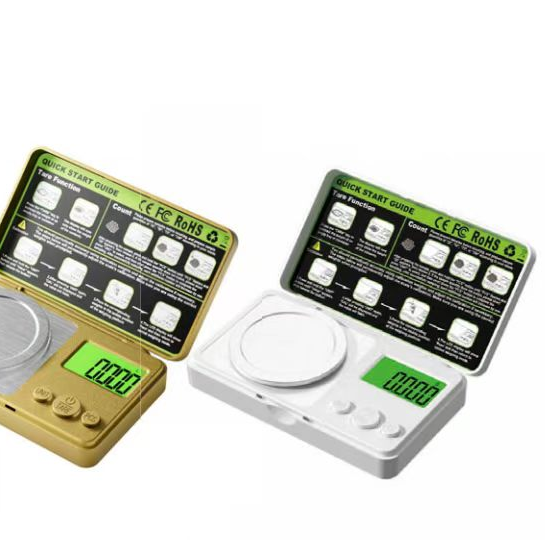
A 0.001 g display that does not settle is not usable for reference weighing. In this class the pan is the first variable: pocket precision models stay on small pans such as the 5 cm platform of the CX-555A, while bench balances add a draft shield, and the DH-JCS-2 is listed at 28 x 30 x 32 cm including one. Power source, housing and feet are the other variables, and the catalogue does not measure them: mains adaptors, draughts and an unsteady bench are things to test with a sample in the room where the instrument will actually be used.
What a milligram scale is actually bought for
Demand for 0.001 g resolution comes from a small set of trades: gemstone and precious-metal weighing where carat fractions differ by less than a hundredth of a gram, laboratory and educational work, supplement and pigment dosing, and quality checks on small components. Those uses share a requirement that kitchen scales never face: the sample is small, the tolerance is tight, and the operator needs the reading to repeat when the same item is placed again. If the application is portioning coffee or flour, a 0.1 g or 1 g scale is the correct purchase and the extra digits are money spent on a capability the job will not use.
Units matter as much as resolution
Buyers in this class rarely weigh in grams alone. The CX-555A carries g, oz, gn, ct, tl, dwt and ozt; the DH-JCS-2 and DH-456A publish their own unit sets, and they are not identical. Carat (ct), grain (gn), pennyweight (dwt) and troy ounce (ozt) are standard in jewellery and bullion work, and tael (tl) still appears in parts of Asia. Compare the exact unit strings on the two spec sheets rather than assuming a higher-precision model carries every mode.
Calibration: ask what ships with the instrument
Milligram instruments are checked against an external reference weight, and whether a calibration weight is included with the scale or sourced locally is a question for the supplier on each order rather than an assumption from the catalogue. Two things are worth settling before the carton is sealed: which calibration weight the model expects, and who supplies it. A scale that arrives without a weight can still be verified against a certified set, but the buying team should know which case it is buying.
Packing and handling for a fragile instrument
The CX-555A ships 60 pieces per master carton of 41.5 x 31.5 x 32.5 cm at 12.2 kg gross, with each unit in a 15 x 14.9 x 2.5 cm colour box and a unit weight of 188 g. The DH-456A, DH-456B, DH-JCS-1 and DH-JCS-2 are larger bench instruments whose packing is confirmed per order rather than fixed on the catalogue page, so ask for the carton figures before you commit. For this class, ask for the carton drop height and the internal protection in writing as well; those two answers say more about how the instrument will arrive than the carton dimensions do.
A short checklist before you order
Confirm the capacity tiers you actually need, the unit set your market quotes in, the pan size, the power source, whether a calibration weight is included, and the carton protection. Then order one sample and place the same test piece ten times on the bench you will use, followed by two or three known weights across the range. Repeatability is necessary but not sufficient: an instrument can return the same reading every time and still be biased, which is why the known-weight check matters before a full order. ZmoTek can quote the 0.001 g models alongside the 0.01 g and 0.1 g lines so the comparison happens on one page.