Buying Guides
Soap Making Scale and Candle Making Scale: 0.01 g vs 0.1 g
Fragrance and lye need finer steps than cooking. How to choose 0.01 g or 0.1 g for soap and candle batches, tare with a pitcher, and keep a caustic bench clean.
Why craft batches need finer steps than cooking
Most cooking tolerates a gram. Soap making and candle making often do not. A fragrance load is a small share of the batch, and lye is calculated against the oils rather than added by feel. When a recipe is scaled down to a test batch, the smallest adjustment the scale can show becomes part of the formula. That is why a kitchen scale reading 1 g is a poor fit. Choose the scale by batch size, not by the number of digits on the display.
Why a 0.01 g scale changes the batch
Fragrance oil is the clearest case. It is usually written as a percentage of the oil weight, so it must be accurate before the batch is poured. A 0.1 g step may be acceptable in a large melt, but in a small test batch the same step is a much larger share of the total. Lye is less forgiving: the recipe depends on exact oil weights and a calculated lye figure. A scale that rounds both values in the same direction can move the batch away from the intended formula. That is the argument for a 0.01 g scale for fragrance and lye work, but check the resolution against the batch you actually make.
When 0.1 g is the right resolution
Bulk changes the answer. Once a batch is measured in kilograms, a 0.1 g display is a sensible working resolution: it is stable, quick to settle, and the step is small relative to the total. The DH-K21 is a 0.1 g scale on its 3 kg and 5 kg ranges, with a 1 g top tier at 10 kg. That ladder suits a production bench weighing oils, wax or base in larger pours. The same logic applies to a 2 kg or 3 kg batch on the DH-8902: once the load is above 1 kg, the 0.1 g tiers take over and the 0.01 g tiers are there for small additions.
A split ladder covers both jobs
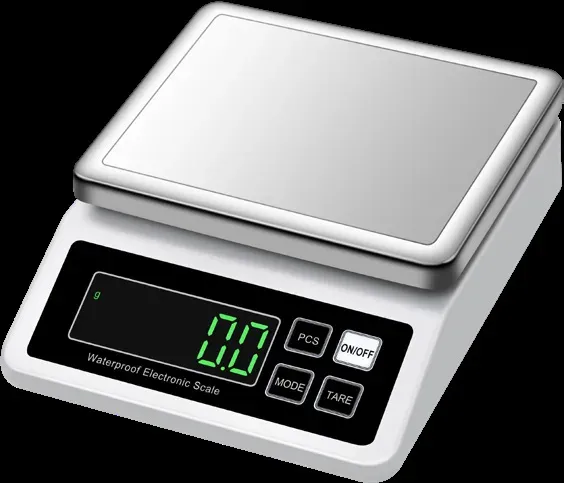
A split ladder is often the practical answer for a craft studio. The DH-8902 carries 500 g and 1 kg at 0.01 g, then 1 kg, 2 kg and 3 kg at 0.1 g. The DH-I200 goes down to 200 g at 0.01 g and up to 3 kg at 0.1 g. The DH-5KW starts at 500 g/0.01 g and moves to 0.1 g from 1 kg. Read those ladders as two instruments in one housing: the fine tier for fragrance, color and lye, the coarse tier for the main oil or wax. Check which tier your usual batch falls into before comparing models or pan sizes.
Tare with the pitcher, not the bowl
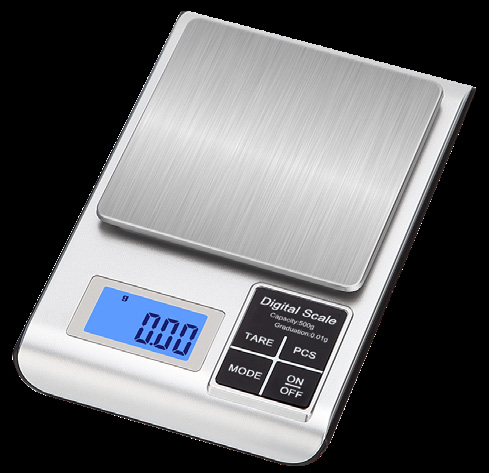
Tare is the workflow that keeps a batch clean. Put the pitcher on the platform, press tare, and add fragrance or lye directly into the pitcher. The scale then shows only the added weight, and you avoid transferring a sticky or caustic material into a second container. The DH-8902 lists a large tray at 14.3 x 10.6 x 2.3 cm and a small tray at 10.4 x 10.4 x 0.8 cm; the larger tray is the one that will hold a pouring pitcher safely. Confirm the tray material and how it seats on the platform, because a tray that rocks will not tare consistently.
Caustic-safe habits around the scale
Lye is the material that sets the house rules. Keep a dedicated scale, or a dedicated tray, for caustic work and do not put it back on the food shelf. Wear gloves and eye protection, work in a ventilated area, and follow the lye supplier's safety data sheet. Wipe the housing after every session rather than waiting for a spill to dry, and cover the scale when it is not in use. A separate tray and a wipe-down routine are simple, but they are the habits that keep a craft scale usable and the next batch uncontaminated.
What else to specify on a craft scale
The rest of the specification is about the bench. Pan size decides whether a pitcher or a melting pot sits stably; the DH-5KW and DH-I200 both use a 10 x 10 cm pan, while the DH-K21 uses 14 x 14 cm. Units matter if you sell in different markets: the DH-8902 lists g, gn, oz, ozt, dwt, ct, lb, ml and tl, while the DH-K21 lists g, gn, tl, ml, lb, ct, ozt and kg. Power is the third item: AAA batteries suit a bench without outlets, and USB versions are available on several models. Ask for the unit list and power option in writing.
Test one sample before the first order
Order one sample and run your own recipe before you commit to a production run. Weigh the same fragrance amount ten times and watch whether the last digit settles or drifts. Then weigh a 500 g and a 2 kg load to see how the scale behaves at the top of each tier. Check the tare with the actual pitcher you use, not a test cup. Finally, ask for the master carton figures: the DH-8902 packs 50 pieces in a 73 x 33.5 x 21 cm carton, while the DH-K21 packs 30 pieces in a 52.5 x 38.5 x 32.8 cm carton. Those numbers belong in your freight quote.