Buying Guides
Why Digital Scales Cost Different: What to Compare
Two quotes can match on capacity and precision and still differ. The build lines behind the gap, and the questions that show which one changed.
The spec sheet hides the difference
Two quotes can carry the same capacity, the same resolution and the same unit list, and still differ by a wide margin. The visible specification describes what the scale does, not how long it will do it. The difference sits in parts that are not usually printed: the load cell, the stiffness of the housing, the display, the power circuit, the switches, the packing and the checks before the carton is sealed. A scale price difference is a question, not a verdict.
Load cell class and what stability depends on
The load cell is the element that turns weight into a signal, and it is the first place two quotations can differ. Two cells can share a capacity rating and differ in accuracy class, temperature compensation and creep behavior. Ask for the cell's rated capacity relative to the scale's capacity, its accuracy class and its temperature range. A scale that reads correctly at room temperature and drifts in a warm shop is usually telling you about the cell, not the display.
Housing rigidity shows up as drift
A housing that flexes under load puts strain into the cell and shows up as a reading that moves when the load is placed off-center. Added ribs, a thicker base and metal inserts are hard to see in a photo. Test it: place a weight at the center of the pan, then at each corner, and compare. A stiff body repeats; a flexible one changes with position. Ask what the housing is made of and whether the pan sits on a metal sub-frame.
The display is a build choice with a visible result
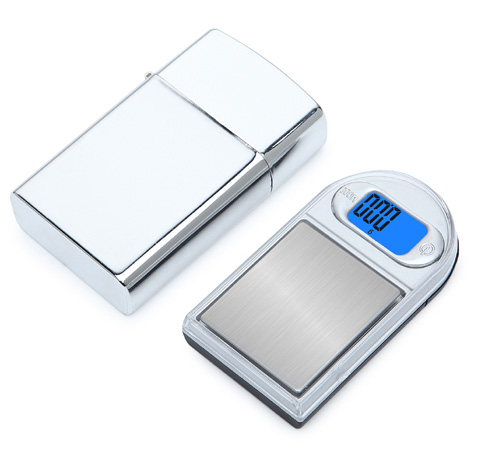
Display choices change both the build and the user experience. Ask which display technology is fitted, how the window is protected and what it costs to replace if it cracks. The range shows the spread in window size: the DH-A06 lists 2 x 1.2 cm, the DH-A10 5.5 x 2.1 cm, the DH-406 6.9 x 3.3 cm and the DH-AS01 a rear display of 10.8 x 2.8 cm. Decide what the operator must read before specifying a larger window.
Power design: cells, charging and protection
Power is often the least examined part of a quotation. A coin cell, two AAA batteries and a USB charging circuit are different designs with different part counts. Charging adds a connector, a control circuit and protection against overcharge; a removable battery door adds tooling and a wear point. Ask which cells the model takes, whether a charging version exists, what protection the circuit has and whether the connector is rated for repeated use. Ask for the battery type by model code as well, since a charging version may sit under the same family name.
Switches, feet and the parts that fail first
The parts a user touches most are rarely the parts a quotation explains. Membrane keypads, tactile switches and button legends differ in life and feel. Feet differ in hardness and height, and a hard foot on a smooth counter lets the scale slide during loading. Ask which pan material is fitted, whether the pan is replaceable and what a spare costs. These are small items with a large effect on returns.
Packaging is part of the product cost
Packing is where two quotes can look identical and behave differently. Internal inserts, molded pulp, foam, bagging and carton strength vary between offers, and they are the first items to change when a quote is reduced. Ask for the drop test the carton is designed to pass, the internal protection and the master carton dimensions. Then compare packing density: the DH-A10 packs 20 pieces per master carton of 39 x 34 x 28 cm, while the DH-328 packs 100 pieces per master carton of 60 x 46.5 x 29.4 cm. A lower piece count per carton can be a protection choice or a cost problem; ask which.
QC steps are invisible in the unit price
Incoming inspection, load cell matching, calibration, aging and final functional checks all consume time. A supplier that skips them can quote lower and still ship a scale that passes a quick check on arrival. Ask for the inspection sequence, the sampling plan and the record that travels with the batch. Ask whether the record names the operator and the date, because an unsigned checklist is hard to trace later. If the answer is 'we test every unit' without a written list, ask what is tested and at what load. The quality level is in the process, not in the adjective.
The question that turns a gap into a spec
Take two quotes for the same model family and put them side by side. Ask each supplier to mark, line by line, where the two builds differ, and to name the part behind each difference. A supplier who can answer is describing a product; one who cannot is describing a price. Keep both replies in the same order so the rows line up.
That comparison also protects the buyer from paying for capability the job will not use. A shop that weighs trays to the nearest gram does not need 0.01 g resolution; a kitchen that portions spices does. Once the differences are on one page, the cheaper quote can be judged on what it kept, and the dearer one on what it added. The number stops being the argument. Ask ZmoTek to confirm the build differences on your next quote.