Buying Guides
Jewelry Scale for Shop Counters: What Changes
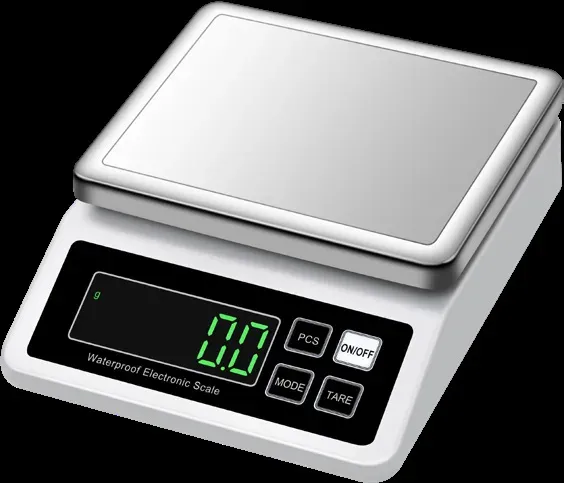
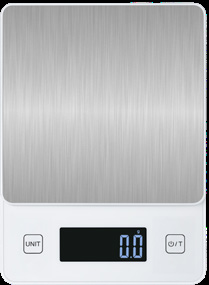
A shop counter scale is not a pocket scale with a bigger lid. Counter space, customer-facing display, tray tare, shift repeatability and unit set decide the model.
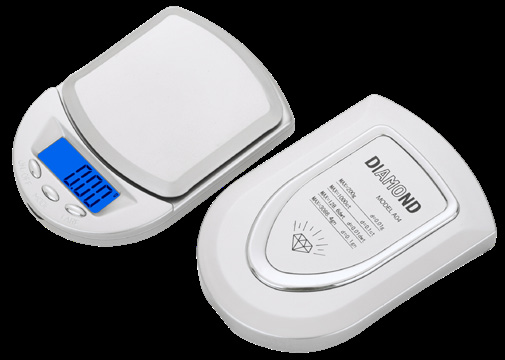
The buyer's pocket scale is not the shop's counter scale
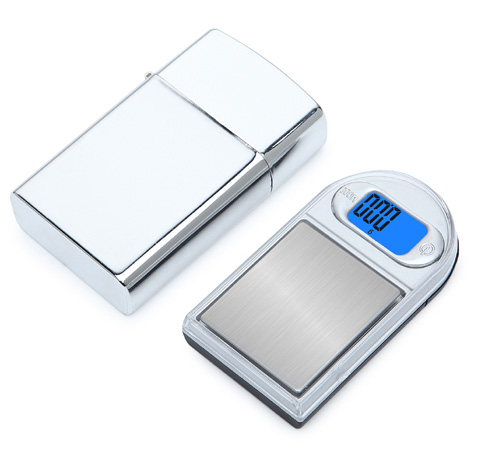
A pocket scale is bought to be carried, protected and used occasionally. A retail jewelry weighing scale is bought to be looked at, tared dozens of times a day and read by a customer on the other side of the glass. A pawn shop scale may sit behind a security screen, which changes the viewing distance again. The same 0.01 g resolution serves all three, but the decision criteria do not.
Counter space is a real constraint
Jewelry counters are crowded with mats, trays, tags and a cash area. The footprint of the scale has to fit without moving the tray line. Among the models compared here, body sizes run from 7.6 x 4.4 cm on the DH-333 to 12.8 x 8 cm on the DH-A07, with the DH-A05 at 8.5 x 4.5 cm, the DH-B05 at 8.8 x 6 cm and the DH-K80 at 11.9 x 7.1 cm.
The display has to face the customer
A shop scale is often read twice: by the operator and by the customer. Display size is the first variable. The DH-B05 lists 3.3 x 1.3 cm, the DH-928 6 x 1.9 cm and the DH-K80 6.3 x 2 cm, all on bodies that could sit on a counter. A larger window helps at conversation distance, but only if the scale can be turned toward the customer without hiding the pan. Check the viewing angle with the tray loaded.
Tare with a tray, not a bare platform
Most shop weighing happens in a tray or on a dish, so the scale must tare that weight and keep the net reading stable. Platform size decides what fits: the DH-A05 lists a 3.9 x 5 cm pan, the DH-B05 5.5 x 5.5 cm, the DH-928 7 x 6.4 cm and the DH-K80 7.3 x 6.6 cm. A tray wider than the pan overhangs it and puts load on the pan edge, which tips the reading. Ask for the tare range and test with the actual tray.
Repeatability across a shift
A shop scale may be switched on for a full day and used between customers. Repeatability is therefore a time question, not only a single-weighing question. Power design is part of it: the DH-333 runs on one CR2032 coin cell, while the DH-A05, DH-A07, DH-928 and DH-938 use two AAA batteries and the DH-A07 also offers a USB charging version. Ask how the reading behaves after warm-up and after an hour of idle time.
Temperature and air movement also affect a 0.01 g reading. A counter near a door, an air-conditioning vent or a sunny window is a harder location than a back office. Leave the sample on the counter through a working day, zero it between customers and note whether it returns to zero. A scale that needs a re-zero before every customer is a poor counter tool, however good its spec sheet looks.
Capacity: the exact ladder behind the 0.01 g label
The 0.01 g class is not one capacity. The DH-A05 and DH-B05 publish 100, 200, 300 and 500 g at 0.01 g; the DH-B05 adds 500 g at 0.1 g. The DH-333 stops at 200 g at 0.01 g. The T2 runs to 700 g and 1 kg at 0.01 g, with 500 g and 1 kg at 0.1 g. The DH-A07 reaches 1 kg at 0.01 g, plus 500 g and 1 kg at 0.1 g. The DH-928, DH-938 and DH-K80 hold 0.01 g to 500 g, then 0.1 g at 500 g and 1 kg.
The unit set has to match the local trade
This is a shop decision, not a units lesson. The unit set has to match the language the counter quotes in, and the sets differ across models. A counter that quotes gemstones in carats needs ct on the keypad; one that buys scrap gold by pennyweight or troy ounce needs dwt and ozt; a market that still quotes tael needs tl. The DH-A07 carries no ct, for example. Read the exact string on the quote, then check how many presses separate the trade unit from grams. A unit that shifts under a thumb is a pricing error waiting to happen.
Matching models to the counter
For a compact counter with limited space, the DH-333 or DH-B05 keeps the footprint small. For a customer-facing display and a larger tray, the DH-928 or DH-K80 gives more window and pan. For 1 kg at 0.01 g, the DH-A07 and T2 are the models to compare, with the DH-A07 adding USB charging. These are starting points, not rankings: confirm the unit set, the tray fit and the repeatability on a sample.
Ask before you order
Put five questions to the supplier: which unit modes are on the keypad, what tray fits the pan, what the tare range is, how the display faces a customer, and what happens to repeatability over a long shift. Then weigh the same piece ten times, with a customer-side read after each one. A model that passes that trial on your own counter is the one to order. Ask ZmoTek for a sample and run it.