Buying Guides
Espresso Scale Guide: Dosing, Footprint and Capacity
What a dosing scale must do in 15 to 20 g of coffee, why 3 kg is enough, how footprint decides fit on a drip tray, and when a timer earns its place.
Dosing is a 15 to 20 g decision
Espresso dosing is a small-weight task. A modern espresso dose is roughly 15 g to 20 g of ground coffee, and a 0.1 g step is about 0.5% to 0.7% of that dose. That sounds fine until the barista adjusts by two or three steps and the shot changes. The scale has to settle quickly enough to read the dose before the basket goes into the group, and it has to hold a stable value while the portafilter is lifted off. Capacity is almost irrelevant at this weight; response and fit are not.
Response speed matters more than a long feature list
A dosing scale is judged by how fast the number settles, not by how many modes it offers. Load cell response, filtering and display refresh all affect the delay between placing the portafilter and reading a stable value. A scale that takes two seconds to settle slows every dose; a scale that jumps past the target makes the barista chase the number. Spec sheets rarely publish settling time, so test it with a sample and a stopwatch. Place an 18 g load, time the settle, and repeat five times before you judge the model.
Footprint: the drip tray is the real constraint
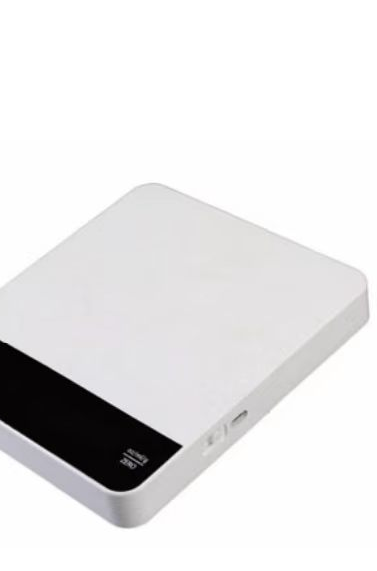
The drip tray sets a hard limit on footprint. The C05 measures 12.8 x 14.8 x 2 cm; the DH-8705 measures 12.7 x 14.9 x 1.9 cm; the DH-8705D measures 15 x 13 x 2.4 cm; the DH-8702 measures 15.3 x 13.1 x 2.9 cm; the DH-E70 measures 18 x 13 x 2.7 cm. Height matters as much as width: a scale that fits between the drip tray rails but lifts the cup too close to the spouts will not work. Measure the clearance under your group head with the cup and portafilter in place before comparing footprints.
Why 3 kg is plenty for espresso
Three kilograms is plenty for espresso because the load is a portafilter, a basket and a dose, not a brewing batch. Even a double basket with a heavy handle stays far below 3 kg. The extra capacity on a 5 kg model is useful only if the same scale also handles brew water or a larger vessel. The C05 and DH-8705 are 3 kg/0.1 g; the DH-8705D and DH-E70 offer 3 kg/0.1 g and 5 kg/0.1 g; the DH-8702 offers 1 kg/0.1 g, 2 kg/0.1 g, 3 kg/0.1 g and 5 kg/0.1 g. Choose the smallest capacity that covers the vessel, then prioritize fit and response.
Dosing scale versus brew scale
A dosing scale and a brew scale are different tools: dosing needs a fast settle and 0.1 g steps across a 15 g to 20 g load on a footprint that fits the drip tray, while a brew scale sits under a carafe or cone. The DH-E70 18 x 13 cm body and removable silicone draining mat suit a brew station; the C05, DH-8705 and DH-8702 are compact enough for dosing.
Whether a timer earns its place
The DH-8702 and DH-E70 are listed with built-in timers, so if a timer matters, compare those two first. A timer changes workflow, not dose accuracy: it helps track a shot or a pour interval, while the scale's contribution to the dose is still weight and response. For espresso, the shot clock usually lives on the machine or the grinder, and the scale's job is to report weight quickly. Do not buy a timer instead of testing settle time and footprint; those two decide whether the scale works at the bar.
Units and power in a cafe
Units and power should match the bar's routine. The C05, DH-8705 and DH-E70 list g, oz and ml; the DH-8705D and DH-8702 list g and oz. The C05 runs on 3 x AAA batteries or charging; the DH-8705 and DH-8705D use USB charging; the DH-E70 uses 3 x AAA batteries or USB; the DH-8702 uses USB charging. A USB scale ties the bar to a cable and a spare port; an AAA model needs a stock of cells but no cable. Check which is easier to support in your market, and confirm what charging accessory ships in the box.
A sample test for dosing
Test a dosing scale the way a barista will use it. Put the portafilter on the scale, zero it, dose 18 g, and repeat ten times; note whether the reading settles before the basket leaves the scale and whether the same dose repeats. Check the footprint with the cup and portafilter in place on the drip tray. Then run the same test with a 5 g and a 20 g load to see how the display behaves at the ends of the working range. Request a sample from ZmoTek before you choose a model for a cafe or a retail line.