Buying Guides
Commercial Kitchen Scale Guide: Prep, Portion, Receiving
A commercial kitchen needs different scales at prep, portioning and receiving. How to match capacity, pan size, hygiene and power to each station before a wholesale order.
One kitchen, three weighing jobs
A commercial kitchen scale is not one purchase. A kitchen needs a scale at each point where weight decides the result: prep, portioning and receiving. A 20 kg model is the wrong bench for a 180 g protein portion: the body takes counter space the portioning station does not have, and a small plate sits alone in the middle of a large platform. A portion scale with a small pan cannot take a stockpot or a 15 kg case of vegetables. The buying decision is therefore a mix, not a model. Start by listing the three stations, the usual load at each, and the container each one weighs.
Portion consistency starts with resolution
Portion consistency is where the choice between 1 g and 0.1 g matters. A restaurant portion scale with 1 g steps is adequate for a 200 g or 300 g portion where the recipe allows a few grams of drift. It is not adequate for a 20 g garnish, a spice blend or a small sauce batch, where one gram is a visible share of the target. The DH-406 covers 3 kg and 5 kg at 0.1 g, then offers 10 kg at 0.1 g, 10 kg at 1 g and 15 kg at 1 g. That ladder lets one model handle fine prep and heavier batches, but check which tier your portion size falls into.
Prep is a capacity problem
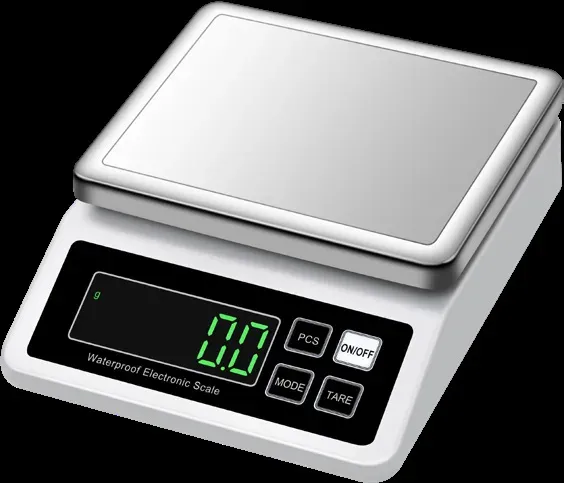
Prep is mostly a capacity problem. Dough, stock, marinated protein and bulk vegetables arrive in loads that punish a small platform. The DH-A11 covers 5 kg, 10 kg, 15 kg and 20 kg at 1 g, in a 23 x 16 x 2 cm body. The DH-A301, DH-A302 and DH-A303 all cover 5 kg to 15 kg at 1 g, with a 23 x 17 cm pan. For a kitchen that preps in 20 kg batches, the DH-A11 is the only one of these with a 20 kg tier. Choose the top capacity above your heaviest routine load, not at it, so the operator is not weighing at the ceiling every day.
Platform size versus counter space
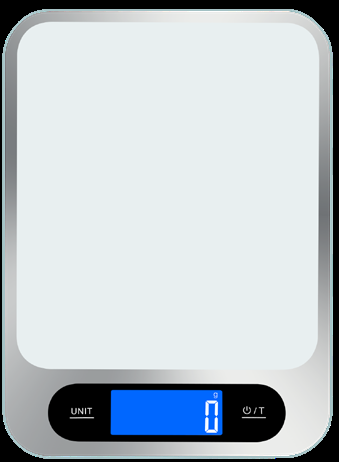
Platform size and counter space pull in opposite directions. The 23 x 17 cm pan on the DH-A301, DH-A302 and DH-A303 holds a large mixing bowl or a full batch of cut vegetables, but it also takes the space of a small cutting board. The DH-406 uses an 18 x 18.5 cm pan in a 25.5 x 19 x 4.4 cm body, and the DH-8801 uses a 17.4 x 15.5 cm pan. Measure the actual counter at each station, then put a sample container on a paper template of the pan. A scale that does not fit is a scale that gets moved and never used.
Speed at the pass
Speed at the pass is rarely about the display alone. It is about whether the operator can tare a container, switch to the unit the recipe uses, and read the result without leaving the station. The DH-A301, DH-A302 and DH-A303 carry ten unit modes, including g, kg, lb:oz, fl:oz, ml, milk ml and tl. The DH-A11 carries five: g, kg, lb:oz, ml and fl:oz. A kitchen that works only in grams needs fewer modes, not more. Ask for the exact unit list and test the buttons with gloves on.
Hygiene surfaces and the wipe-down test
Hygiene is a design question before it is a cleaning question. Look for a platform that lifts off or wipes clean, a housing without deep seams around the display, and a tray that does not trap flour or meat juice. None of that can be judged from a capacity table. Ask the supplier for the platform material, the seam construction and the cleaning method they recommend. Then test a sample with the sanitizer your kitchen uses. A scale that survives the shift is more valuable than one that only looks sealed.
Power in a wet kitchen
Power is the quiet failure point in a wet kitchen. The DH-A11, DH-A301, DH-A302, DH-A303, DH-406 and DH-8801 all list 2 x AAA batteries, with a USB charging version available. Battery models avoid a cord across a wet counter, but they need a battery routine. Corded or USB models need a socket near the station and a cable route that does not cross the wash area. Ask how the battery compartment is sealed and where the charging port sits. Those two answers decide whether the scale is practical in a kitchen that hoses down at closing.
Specifying a mixed order
Specify a wholesale order by station, not by model count. Then ask for the carton data for each chosen model. The DH-406 packs 20 pieces in a 59.5 x 37.5 x 44 cm carton, the DH-A303 packs 20 pieces in a 37.5 x 33 x 27 cm carton, and the DH-8801 packs 30 pieces in a 34.5 x 34 x 27 cm carton. Carton shape affects storage and freight when several models ship together, and the piece count tells you how the pallet will stack. Confirm the gross weight per carton as well, because a mixed order is quoted on the combined figure.